
Music Therapy and Memory Care: How Music Can Help Seniors with Alzheimer’s and Dementia
The Healing Power of Music: Transforming Memory Care for Seniors
When words fail and memories fade, music often remains. At Mayberry Gardens, we understand that caring for seniors with Alzheimer’s and dementia requires innovative approaches that honor both the person and their journey. Music therapy has emerged as one of the most promising non-pharmacological interventions for memory care, offering hope and healing when traditional treatments reach their limits.
Musical memory is partially spared in patients with Alzheimer’s disease, despite severe deficits in other memory areas, making music therapy a uniquely powerful tool. With approximately 50 million people globally affected by dementia, families need comprehensive support that addresses not just physical needs, but emotional and cognitive well-being. Our team at Mayberry Gardens stays at the forefront of evidence-based care approaches, helping families navigate the complexities of memory care with compassion, expertise, and hope for meaningful moments of connection.
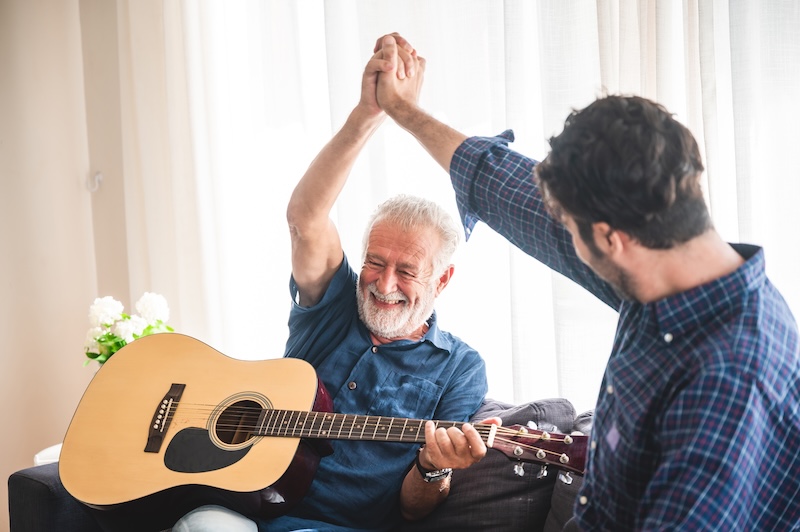
Why Music Therapy Matters in Memory Care
Music therapy offers unique advantages because it activates multiple brain regions simultaneously. The long-term memory of music remains intact until the very late stages of disease progression, occurring because musical abilities tap into deeply ingrained procedural memories and engage brain networks that remain relatively intact even as other cognitive functions decline.
Music can activate the limbic system, subcortical circuits, and emotionally related systems, inducing the sensation of well-being. Research consistently demonstrates that music interventions can improve mood, reduce anxiety and agitation, enhance communication, and strengthen caregiver relationships. Effects include improved mood, reduced depressive scores, enhanced autobiographical recall, and better cognition.
Music therapy is a non-pharmacological intervention that is noninvasive, without side effects, and economical. This makes it an ideal complement to traditional medical treatments, offering families another tool to enhance their loved one’s quality of life without concerns about additional medications.
How Music Therapy Works
Music therapy operates on multiple levels within the brain, creating pathways for connection that bypass damaged areas. When we use musical intervention, we’re looking for areas and networks in the brain that are intact to serve as bridges and help areas that aren’t working well.
The therapy involves two primary approaches: active interventions (playing instruments, singing, clapping, or moving to music) and receptive interventions (listening to carefully selected musical pieces). Professional music therapists work closely with families to identify the most meaningful music for each individual, since not all memories connected to music are pleasant memories.
Evidence-Based Benefits for Seniors
Recent research provides compelling evidence for music therapy’s effectiveness. Compared to control groups, there is improvement in cognitive functions after music therapy application across multiple domains that matter most to families.
Cognitive Benefits: Studies show music therapy enhances memory, attention, executive function, and language skills. Research demonstrates that music therapy can successfully protect autobiographical and episodic memories, psychomotor speed, and overall global cognition in people with Alzheimer’s disease.
Emotional and Behavioral Improvements: Music therapy significantly impacts mood and behavior, with long-term benefits in reducing behavioral and psychological symptoms of dementia, including decreased agitation, reduced depression, and improved emotional well-being.
Enhanced Communication: Perhaps most importantly, music therapy improves communication between seniors with dementia and their caregivers. Studies found that musical intervention improved agitation and anxiety for both patients and caregivers, with social communication improving in both verbal and nonverbal ways, like eye contact.
Practical Implementation in Daily Care
Families can begin incorporating musical elements into daily care routines. Play music from your loved one’s teenage years or early 20s, as music from this era helps encourage recall of long-term memory and often remains most emotionally meaningful.
Create the right environment by eliminating competing noises and ensuring appropriate volume. Observe your loved one’s response – if they seem more engaged while certain music plays, note the type for future use. If they seem anxious, avoid that type of music.
Music therapy can be particularly valuable during difficult transitions or challenging times of day. Many families find that incorporating music into routines helps establish calmer, more connected moments throughout challenging days.
Supporting Families Through Music
The benefits extend beyond the individual to encompass the entire family system. Caregivers often find the person lost to them in the context of music, providing profound comfort and hope to families navigating memory loss challenges.
Music also provides opportunities for meaningful engagement when traditional conversation becomes difficult. Music can elicit positive responses and increase communication even in patients experiencing advanced stages of dementia whose verbal skills have been diminished.
Ready to Explore Music Therapy for Your Loved One?
At Mayberry Gardens, we believe in the transformative power of music to enhance memory care and strengthen family connections. Contact us today to learn more about memory care resources in our community and how we can support your family’s journey with compassion, expertise, and evidence-based care approaches that honor your loved one’s dignity and potential.